P.O Box 01, Nakasongola - Uganda| Tel: 0392 797699 | E-mail: [email protected]

Agricultural Production
Welcome to Nakasongola District
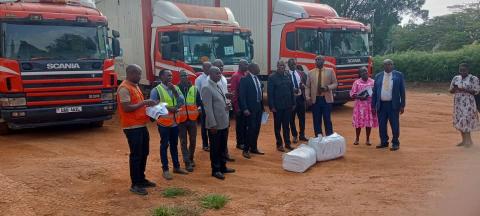
NAKASONGOLA FLAGS OFF 2,889 CARTONS OF MOSQUITO NETS TO COMBAT MALARIA
Nakasongola District has officially received and flagged off 2,889 cartons of long-lasting insecticide-treated mosquito nets from the Government of Uganda in a renewed effort to strengthen malaria prevention and protect communities against one of the country's leading public health challenges.
The mosquito nets, supplied through the National Medical Stores (NMS), will be distributed to households across all parishes in the district beginning next week. Under the distribution plan, each household will receive one mosquito net for every two family members.
While presenting the consignment to the district leadership, the Acting District Health Officer, Mr. Kirya Ronald, confirmed the receipt of the 2,889 cartons and said the distribution exercise forms part of the Government of Uganda's nationwide malaria prevention campaign aimed at reducing malaria-related illnesses and deaths.
Representing the Chief Administrative Officer, the Deputy Chief Administrative Officer, Mr. Kaggwa Daris, commended the Government of Uganda for its continued investment in improving public health through malaria control interventions.
He called upon Local Council I Chairpersons to ensure the mosquito nets are distributed fairly, transparently, and reach all eligible households. Mr. Kaggwa further urged residents to use the nets strictly for their intended purpose, warning against their misuse for activities such as fencing gardens, fishing, or constructing poultry shelters.
The District Chairperson, Mr. Semanda Rogers Kulaba, witnessed the flag-off of the consignment to the parishes and announced that household distribution will commence next week. He noted that the exercise is expected to benefit families across the district, with allocations based on household size to ensure equitable coverage.
Speaking during the ceremony, the Resident District Commissioner (RDC), Mr. Bandeeba Festus Besigye, officially flagged off the consignment to the parishes and applauded the Government of Uganda for prioritising the health of its citizens through sustained malaria prevention programmes.
The RDC encouraged residents to complement the government's efforts by sleeping under insecticide-treated mosquito nets every night, eliminating stagnant water around their homes, clearing bushes where mosquitoes breed, and maintaining proper sanitation to reduce mosquito breeding sites.
He also directed sub-county leaders to closely supervise the distribution exercise to ensure transparency, accountability, and equitable access to the mosquito nets throughout the district.
District leaders expressed confidence that the mass distribution campaign will significantly reduce malaria infections, lessen the burden on health facilities, and improve the overall health and well-being of communities across Nakasongola District.
Wednesday, February 7, 2018
The District grows different crops for both home consumption and commercial purposes. These include; cassava, maize, bananas, beans, sweet potatoes, millet, mangoes among others.
However there are several diseases and pests which affect our crops. For example, Maize is being attacked by stack borer and storage weevils as pests and maize streak as a disease, bananas are being attacked by pests like nematodes weevils, diseases like sigatoka and streak virus, cassava is being attacked by pests such as mealybug, green mite and diseases such as mosaic virus and brown streak virus Etc.

Animal husbandry is practiced in different parts of the District and animals reared are; cattle, goats, sheep, pigs, local poultry and exotic poultry both for home and commercial purposes. There are various types of farming systems used by the district for different animals. These are; tethering, free range, ranching, housed and zero grazing, In the production of goats the district mostly uses tethering followed by free range and ranching, in cattle rearing tethering, free range and ranching, in sheep production the district uses free range, in pig production tethering, free range and housed and in local poultry free range well as in exotic poultry housed.
The following are some of the diseases that attack the animals; Tick borne disease attacks cattle and goats, lumpy skin attacks cattle, African swine fever attacks pigs, tryps attacks cattle, rabies attacks all animals, brucellosis attacks cattle, goats and pigs, helminthiasis attacks all the animals and new castle disease attacks both local and exotic poultry.